Why Your Sunday League Team Shouldn't Play Out From the Back
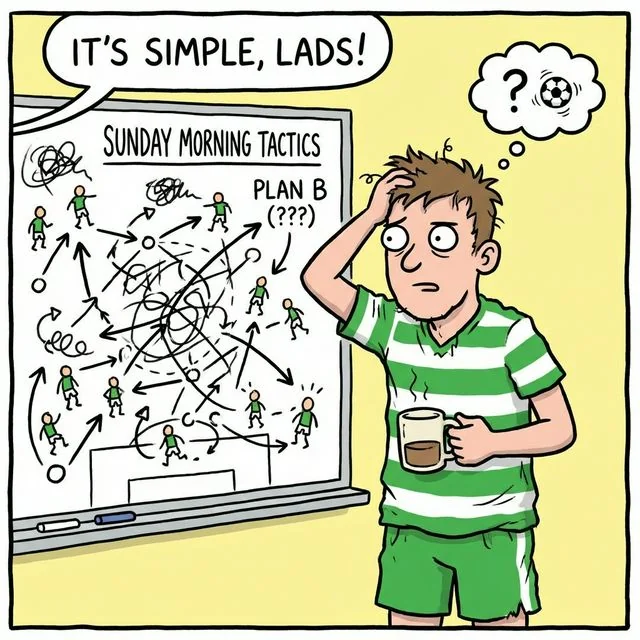
You watched Pep on Tuesday. It's Sunday. It's raining. Your centre-back had six Jägerbombs last night. Someone's dog is warming up on your half of the pitch. Yet somehow, your captain thinks this is the perfect time to implement a Manchester City-style build-up.
This is not the Etihad.
According to entirely fabricated but entirely believable statistics, seventy-eight percent of Sunday League goals conceded start with the phrase "one more pass." The remaining twenty-two percent begin with "trust the process," a phrase nobody in your squad can actually define.
Let me introduce you to the protagonists of this tactical disaster. There's Big Dave in goal, who insists he "used to play academy" despite evidence suggesting otherwise. Ball-Playing Ben occupies centre-back, currently battling last night's questionable decisions more than opposition strikers. Then we have Captain Tactical, whose entire tactical knowledge comes from one YouTube breakdown he watched while on the toilet.
Trust the process, they say. Nobody knows what the process is. But we're about to find out why it doesn't work when your pitch resembles a ploughed field and your goalkeeper's distribution range is either six yards or sixty yards with absolutely nothing in between.
The Myth of Universal Tactics
Not all tactics are transferable from the professional game to Sunday League football. This isn't controversial. It's just basic common sense when you factor in the reality of amateur football.
Just because Man City do it doesn't mean you can. Just because you own moulded studs doesn't make you Kyle Walker. Your teammates are excellent players for Sunday League, but expecting them to execute press-resistant passing sequences after Saturday night is like expecting your car to fly because you filled it with premium petrol.
- Champions League Football: Press resistance through coordinated movement, exploiting passing lanes with precision timing.
- Sunday League Football: Panic resistance (or lack thereof), navigating mole hills and divots, someone shouting "MAN ON" three seconds too late.
The gap between professional and amateur football isn't just about skill. It's about every single variable that makes football work. When Pep Guardiola's team plays out from the back, they're operating on a perfectly manicured surface. Your Sunday League side trains on Thursdays. Sometimes. When enough people turn up.
The Reality of Sunday League Pitches
The Bobble Factor: A Scientific Analysis
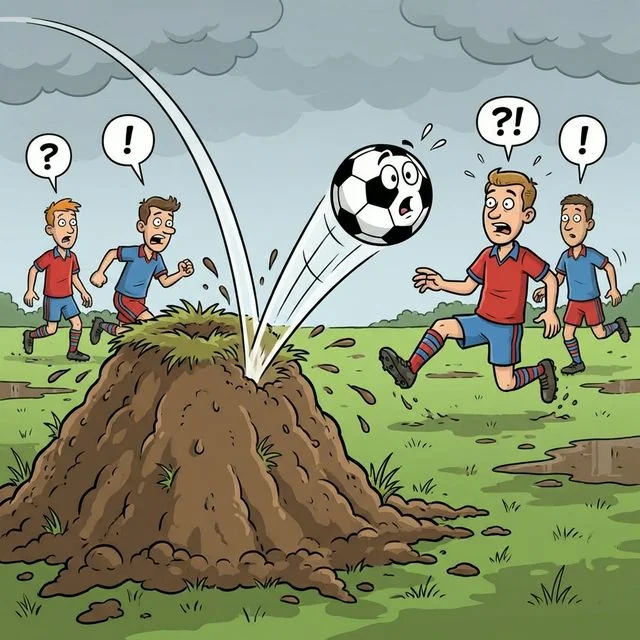
Welcome to the world of Expected Bobbles, or xB as we'll call it in proper analytical fashion. This metric measures the probability that any given pass will encounter an unexpected surface irregularity, fundamentally altering its trajectory and destination.
Professional pitches have an xB rating of approximately 0.2. Sunday League pitches operate somewhere between 4.7 and "are we sure this is actually grass?" The Grass Density Variance on your average council pitch is so extreme that groundskeepers have stopped measuring it. They just shake their heads and walk away.
Then we have the Puddle Interference Index™, a proprietary metric that calculates how many standing bodies of water exist on the playing surface. On a typical Sunday morning, your pitch scores a solid eight out of ten, with bonus points awarded if the puddle near the penalty spot has developed its own ecosystem.
What does this mean for your tactical approach? A five-yard pass becomes a fifty-fifty. The ball changes direction mid-roll like it's being controlled by an invisible hand. Your defender blames "the surface" while standing on what is essentially compost with ambitions of becoming grass.
Forget the Etihad, you're playing on a patch of earth that is actively trying to return to the wild.
Pressing Traps vs Accidental Collisions
Elite teams execute coordinated pressing with timed triggers and passing lanes cut off through intelligent positioning. Watch Liverpool or Bayern Munich press, and you'll see a symphony of tactical awareness.
Watch your Sunday League team press, and you'll see one striker running alone while two midfielders jog vaguely forward. Someone will shout "GO ONNNNN" with the desperate energy of a man who knows this isn't working but feels compelled to shout anyway.
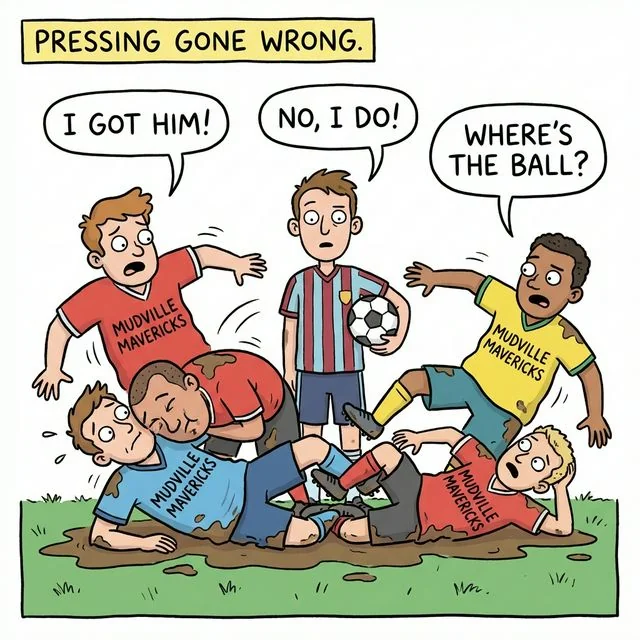
It's not a press. It's a panic. And occasionally, it's an accidental head clash because two players from the same team both decided to close down the same opposition player without communicating.
"Man on!" gets shouted when there is absolutely no man on. The striker presses purely out of spite, having been told by Captain Tactical that "we need to win the ball high up the pitch."
The opposition doesn't even need to press you properly. They just need to exist in roughly threatening positions, and your team will create its own chaos.
The Goalkeeper Conundrum
From Neuer to Neighbourhood Maintenance
You want a sweeper keeper. You want Manuel Neuer, commanding his box, distributing with precision, reading the game like a midfielder who happens to wear gloves.
You have Big Dave. Ironically, Big Dave does sweep. He works for the council. His footballing life involves standing on his goal line and occasionally shouting at defenders.
Big Dave insists he "used to play academy." His distribution range falls into two distinct categories. Sixty yards, achieved accidentally through panic, or six yards, which he somehow never manages despite it being the only pass his centre-backs are asking for.
He once completed a short pass in 2017. We still talk about it. There's talk of commissioning a plaque.
Distribution and Risk Assessment
Let me introduce you to the Sunday League Laws of Distribution, discovered through years of painful trial and even more painful error.
- Law No. 1: The closer you pass to your own goal, the worse it gets.
- Law No. 2: The square ball across your box is cursed. Actually cursed.
- Law No. 3: If you think "this will calm things down," it won't. disaster is imminent.
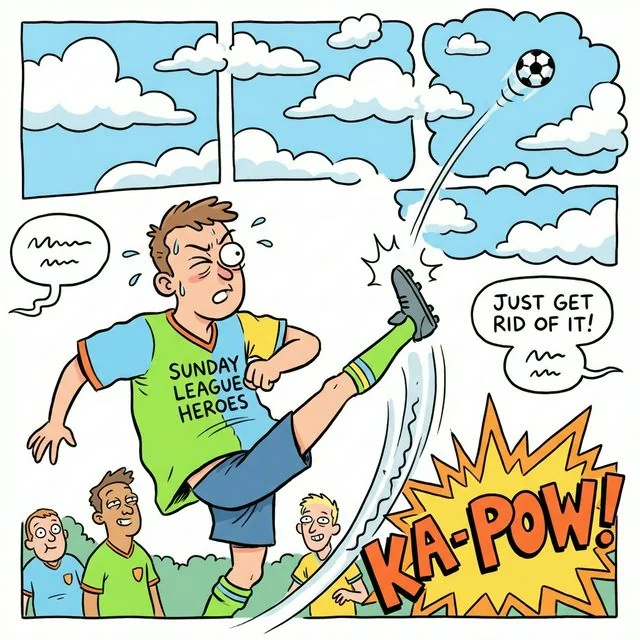
When It Actually Works (Rarely)
Like spotting a rare bird or witnessing genuine teamwork in Sunday League football, there are occasions when playing out from the back might actually succeed. These moments are precious. They're also incredibly specific.
You may attempt build-up play if the opposition displays certain characteristics. If their striker vapes during the warm-up, you have a window of opportunity. If their press consists entirely of pointing at players rather than actually closing them down, proceed cautiously. If their midfield is actively arguing about Fantasy Premier League points while the match is happening, you might survive.
The Five-Minute Rule
This rule could save your season. You may try playing out from the back for exactly five minutes at the start of each match. Set a timer if necessary.
If two wobbles happen, abandon the approach entirely. Switch to what we'll call the Emergency Route-One Protocol. This is not defeat. This is tactical flexibility.
Alternative Tactics for Survival
Let us now discuss proper football. Two banks of players. Two strikers. No inverted nonsense. No false nines. No players occupying "half spaces" because nobody in Sunday League football knows what a half space is, and frankly, nobody needs to.

Four-four-two is a lost religion, and we should embrace it with the devotion it deserves. You don't need inverted fullbacks who drift inside to create overloads in central areas. You need someone who can head the ball when it arrives in the penalty area. Clear it. Reset. Repeat. Read more about tactical shapes in our Match Day Programme.
Hitting the Channels
Let me paint you a picture. Early ball. Into space. Behind their defence. Let your fastest player chase it. This is poetry. This is Sunday League football at its finest.
The channels are your friends. They're open. They're waiting. They don't require seven-pass sequences through midfield. They require one decent ball and a player willing to run.
Know Your Level
This is not the Etihad. It never was. It never will be. And that's perfectly fine.
Big Dave will continue attempting sweeper-keeper distribution despite all evidence suggesting he should stop. Captain Tactical will continue watching YouTube breakdowns and suggesting we implement pressing traps.
Your choice is simple. Attempt to play like Manchester City and create chaos for your own team. Or play the percentages. Clear your lines. Let your fastest players run at their slowest defenders. Respect the hangovers. Respect the pitch conditions.
And please, for the love of everything good in football, stop playing square balls across your own box. Just stop.
The Sunday League Scouting Report
Coming soon: The only app designed specifically for documenting Sunday League tactical disasters. Track your Square Ball Errors, log your Build-Up Catastrophes, and monitor your team's Expected Bobbles (xB). If you insist on playing like Man City, at least track the evidence.
Join the Waitlist