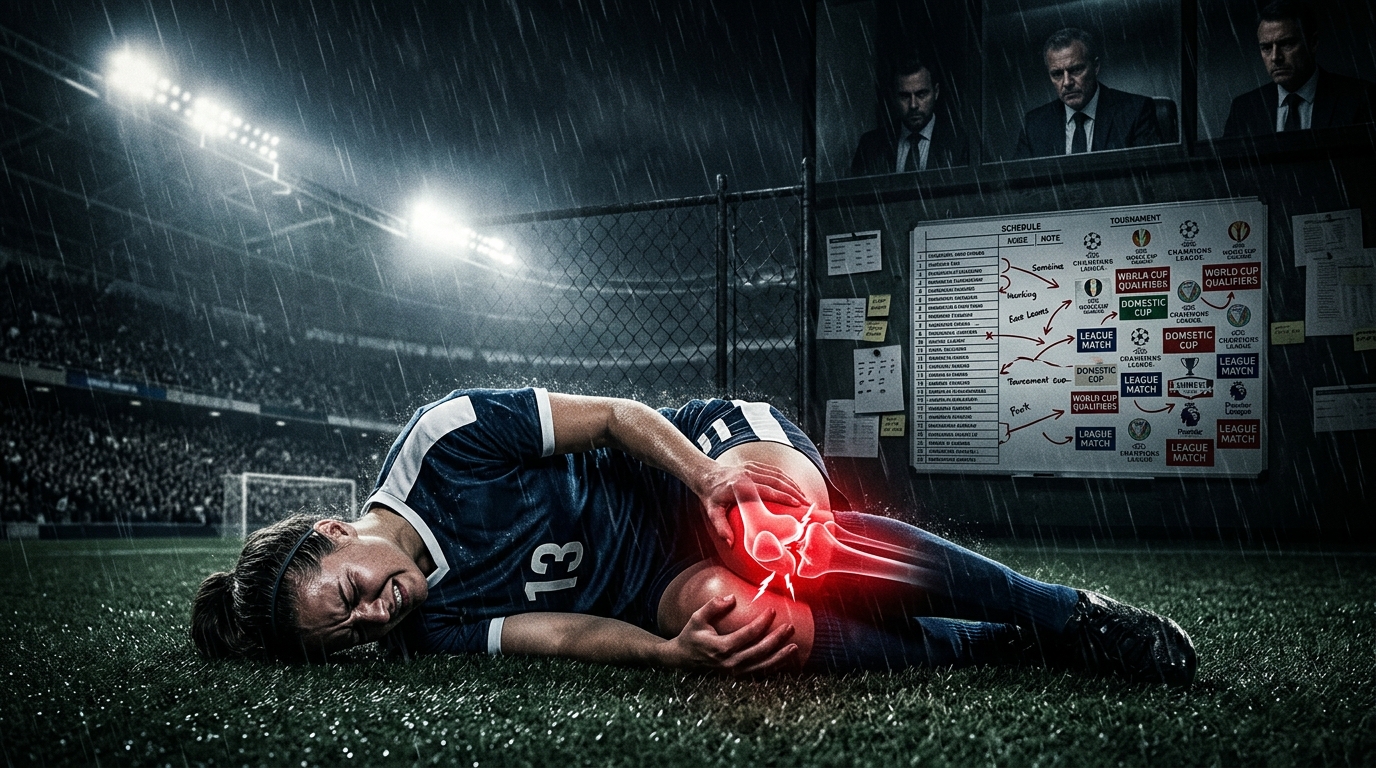
Line up the players missing from the 2023 World Cup. Leah Williamson, the captain who lifted the European Championship trophy for England. Beth Mead, the tournament's top scorer and player of the tournament. Vivianne Miedema, the all-time leading scorer in Women's Super League history. Alexia Putellas, the back-to-back Ballon d'Or winner. Marie-Antoinette Katoto, France's best striker. Catarina Macario, Christen Press, Janine Beckie, Delphine Cascarino.
Hundreds of international caps. Millions of pounds in broadcast value. All of them sat at home watching the tournament on television with crutches leaning against the sofa.
The commentary teams had their answer ready. Pundits and studio doctors drew pelvic angles on digital touchscreens. They pointed to the Q-angle, the angle between the hip and the knee. They cited joint laxity during menstruation. They nodded gravely and concluded that women's bodies were simply ill-suited to modern football.
It was a convenient excuse. If the damage comes down to biology, nobody in a boardroom has to answer for it.
If the ACL epidemic is an unalterable biological fact, FIFA does not have to alter its tournament calendar. UEFA does not have to rethink its expanded European competitions. The Football Association does not have to enforce mandatory summer rest periods. Sportswear manufacturers do not have to scrap their male tooling to build boots suited to women.
Blaming biology costs nothing. Admitting that you ran athletes through an unregulated commercial calendar to sell broadcast packages costs real money.
The Seven-Year Tournament Meat Grinder (2021 to 2027)
Click each summer below to reveal the actual rest window granted to elite players between major international finals and club competitions, compared against FIFPRO's mandatory 28-day health standard.
Act 1: The Seven-Year Calendar Meat Grinder
In men's football, fixture congestion sparks player rebellion. Rodri and Kevin De Bruyne speak openly about striking. Men's squads carry twenty-five to thirty senior players. When Pep Guardiola wants to protect a tight hamstring, he leaves a seventy-million-pound winger on the bench and starts an eighty-million-pound replacement.
In the women's game, the calendar offers no such escape. Between the summer of 2021 and the summer of 2027, elite international female footballers were handed seven consecutive tournament summers without a single off-season:
- Summer 2021: Tokyo Olympic Games (delayed tournament; ended 6 August).
- Summer 2022: UEFA Women's Euros in England (ended 31 July).
- Summer 2023: FIFA Women's World Cup in Australia and New Zealand (expanded to 32 teams; ended 20 August).
- Summer 2024: Paris Olympic Games (ended 10 August).
- Summer 2025: UEFA Women's Euros in Switzerland (2 to 27 July).
- Summer 2026: Inaugural FIFA Women's Club World Cup.
- Summer 2027: FIFA Women's World Cup in Brazil.
FIFPRO guidelines are explicit: professional players need a minimum of twenty-eight days of uninterrupted off-season rest, followed by four to six weeks of pre-season preparation before playing competitive matches.
UEFA and national federations ignored their own medical guidelines. England won the European Championship at Wembley on 31 July 2022. The qualifying rounds for the UEFA Women's Champions League began on 18 August. That gave players eighteen days. Players from Manchester City, Juventus, and Real Madrid went from a major tournament final straight into competitive club football with under two weeks of physical recovery.
The following year proved even worse. The 2023 World Cup final finished in Sydney on 20 August. Seventeen days later, on 6 September, Arsenal flew to Linköping in Sweden for back-to-back Champions League qualifiers against Linköping and Paris FC.
The Arsenal squad looked exhausted inside twenty minutes. They lost on penalties, eliminated from Europe before the domestic season had even begun. In the six months leading up to that qualifier, Arsenal had already lost four key starters to torn ACLs: Beth Mead, Vivianne Miedema, Leah Williamson, and Laura Wienroither.
"We are not robots. We need protection. You cannot expect players to perform at the highest level every three days all year round across multiple tournaments without their bodies breaking down." Millie Bright, Chelsea and England Captain
The World-Class Casualty Tracker (2022 to 2024)
The international footballers whose careers were halted by torn ligaments during the calendar expansion:
| Player | Club / Country | Date of Rupture | Major Tournament Missed | Preceding Matches |
|---|
Act 2: Male-Normative Science & Equipment
When governing bodies run out of calendar excuses, they turn to sports science. Yet sports science in football carries an embarrassing blind spot: it rarely studies women.
In 2021, Dr Amanda Cowley led a systematic review published in Sports Medicine. Her team examined 5,261 sports science research papers published across major international journals between 2014 and 2020.
The conclusion was clear: only 6% of all published sports science studies looked exclusively at female athletes.
Sixty-three percent studied men exclusively. The rest pooled both sexes without separating the data. In practice, elite women's clubs run on training loads, velocity thresholds, recovery routines, and nutrition plans designed for male physiology. Clubs took male data, knocked off a small percentage, and handed the programmes to female athletes.
The Scientific Sex Data Gap (Cowley et al., 2021)
Breakdown of 5,261 peer-reviewed sports science studies across major journals:
Men's Boots Painted Pink
The problem extends straight to the pitch surface.
For decades, manufacturers shaped football boots using a mechanical mould called a last. Every major brand built those lasts around the foot of an adult male.
Women's feet have distinct dimensions: narrower heels, higher arches, and different forefoot-to-volume ratios. When a woman wears a boot built on a male last, her heel lifts inside the cup while her forefoot is squeezed.
Stud design makes this dangerous. Stud lengths and shapes are designed to penetrate hybrid pitches under the weight of an eighty-kilogram man. When a male player sprints and plants his foot, his mass drives the studs into the soil. The ankle rotates naturally, releasing the rotational force.
A female player weighs twenty kilograms less. She produces fast linear speed and sharp rotational acceleration, but less downward mass. The studs do not sink cleanly into the turf; they catch on the hybrid surface.
With the boot locked rigid in the turf, the ankle cannot rotate. The force travels straight up the tibia into the knee joint, loading the anterior cruciate ligament until it tears.
"It is not a women's football boot. It is just a small men's boot made pink. I do not believe the big manufacturers have a boot on the market truly designed for a woman. The rotation that would normally happen around the ankle does not happen there, but in the knee. That rotation stresses the tissue in the knee, especially the ACL." Dr Katrine Okholm Kryger, St Mary's University and UEFA Medical Specialist
The players feel the consequences directly. A European Club Association survey of over three hundred elite female footballers found that more than 82% reported chronic pain, blistering, or discomfort caused by their boots.
When Nike released the Phantom Luna before the 2023 World Cup, marketing it as built for women, the headline star on the promotional posters was Kevin De Bruyne. A small footnote on the product page confirmed that men could wear the boot as well.
Act 3: Squad Depth, Travel, & Pitch Disparities
FIFPRO published its Women's Player Workload Monitoring study in December 2023, tracking 139 elite players across the WSL, France, Germany, and Spain over two seasons.
The findings were stark: 41.7% of monitored players suffered significant injuries. Knee problems accounted for 32% of all injuries, with ACL tears making up 14% of the total.
FIFPRO isolated the key variables. The players who ruptured their ACLs were not genetically vulnerable. They were the players logging the highest minutes, facing the most matches with fewer than five days of rest, and receiving the least recovery in the four weeks before the injury.
The Travel Disparity
Travel was another direct factor. Injured players travelled significantly farther, spent more hours in transit, and crossed more time zones than uninjured teammates.
When a men's Premier League squad travels for a European mid-week fixture, they fly on private charter jets. They have lie-flat beds, dedicated chefs, and immediate recovery equipment. They play, fly home that night, and sleep in their own beds.
Top women's clubs and national squads routinely travel on commercial flights with economy seating and multiple layovers.
Ten hours in a tight economy seat restricts blood flow and tightens the hamstrings and calves. Neuromuscular reaction times drop. When that player steps onto a pitch three days later and cuts sharply, the muscular stabilizers in the leg fire milliseconds late. The muscle fails to protect the joint, and the ligament takes the strain.
The Squad Size Trap
Managers cannot rotate because club finances will not allow it.
WSL rules allow twenty-five registered players, but financial limits leave most clubs with active squads of eighteen to twenty senior outfielders.
When Arsenal lost Mead, Miedema, and Williamson to ACL injuries in the 2022/23 season, Jonas Eidevall had an active squad of fifteen senior players. Core starters like Katie McCabe, Caitlin Foord, and Stina Blackstenius had to play ninety minutes every weekend and every mid-week fixture across four competitions for five straight months.
In May 2023, Laura Wienroither tore her ACL. It was Arsenal's fourth in six months. That was not bad luck. It was the predictable result of running a thin squad into the ground.
Act 4: Solutions They Refuse To Implement
The ACL crisis does not need another symposium. It needs basic regulatory standards.
The solutions are obvious, but governing bodies resist them because every reform costs broadcast revenue:
The 4-Point Governance Blueprint:
- Mandatory 28-Day Off-Season: FIFA and confederations must protect four consecutive weeks of complete physical rest each summer, with fines for clubs or federations that call players in early.
- Squad Expansion Subsidies: Expand WSL and European active rosters to twenty-six funded professional contracts so managers can rotate without collapsing performance.
- Independent Boot Safety Testing: Require independent biomechanical certification for boots used in professional competition, testing stud release profiles specifically for female body weights.
- Charter Travel Standards: Mandate charter flights for international fixtures and European ties requiring long transit, removing the physical toll of commercial travel.
Until FIFA, UEFA, and national federations treat female footballers as professional workers with occupational rights, players will continue to suffer season-ending injuries.
When commentators blame female anatomy, they are protecting boardroom executives. The players' knees did not fail because of their biology. Their knees failed because governing bodies wanted another broadcast cheque.