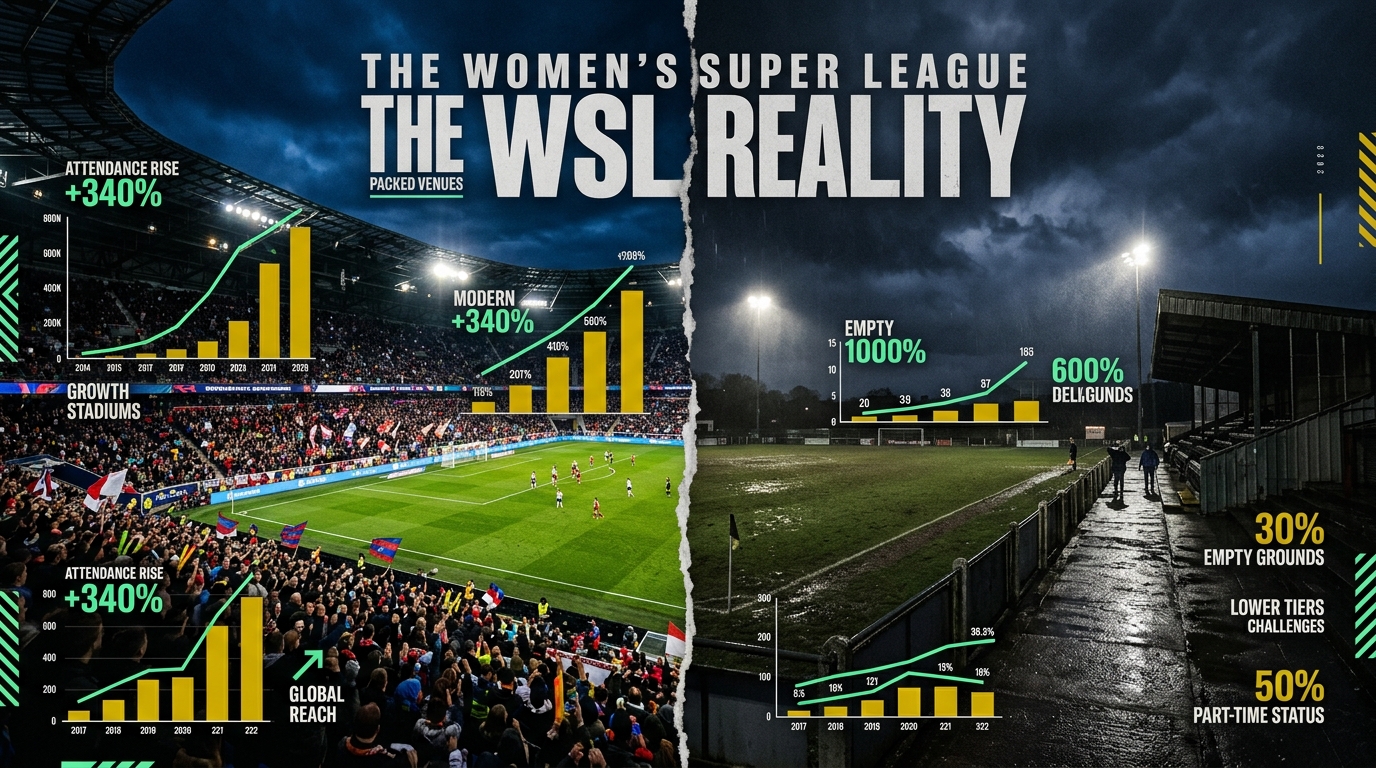
Pull Arsenal out of the attendance data and the Women's Super League is in freefall. Without the Emirates dragging the average up, matchday crowds across the remaining eleven clubs fell nearly 17% over two seasons. Eight of eleven returning clubs lost fans year on year. Manchester United, Manchester City, Liverpool, Tottenham, Brighton: all down 10% or more. The Manchester Derby at the Etihad drew 17,520. The season before: 40,086.
Those are not rounding errors.
The financial damage runs parallel. Southampton slashed its women's team budget and walked. Durham Women FC came within 21 days of shutting operations, kept open only by emergency cash. Blackburn Rovers haemorrhaged money trying to meet regulatory standards it could not afford. The clubs are locked into a financial model they cannot afford, and the board simply refuses to change course.
The headline numbers look fine because Arsenal play in a 60,000-seat stadium. That one fact is doing all the work.
The Attendance Lie
The WSL learned to stage events. Building a sport is something else.
A club fills the Emirates. The press release goes out. 60,000 attend. The league points to the figure as proof of growth. The following Sunday, the same club's away fixture takes place at Boreham Wood, capacity 4,500, open terracing, poor sightlines, forty minutes from the nearest tube station plus a bus. Nine hundred people show up. Both numbers go into the league average.
Clubs treat big-stadium fixtures as corporate marketing exercises. Thousands of free school tickets fill the seats. The photography looks good. Nobody converts. The families who showed up for a novelty do not book for the following week at a non-league ground in a commuter town they have never visited.
The league built a fanbase of occasional visitors. Occasional visitors do not pay wages.
The Football Is Fine. The Empty Stands Spoil It.
Actually sit down and watch the games. The standard of football on the pitch is fine. The technical execution is sharp, the tactical discipline is evident, and the players give everything. The sporting contest itself is not the problem.
The games are utterly spoiled by what surrounds them: cavernous, vacant stands. The look is dreadful. On screen and in person, the hollow echo of empty terraces kills the whole atmosphere and feel of the match. Football is theatre, and theatre dies in an empty room. When a broadcast camera pulls wide to reveal banks of bare grey seats, it announces to the viewer within ten seconds that the event lacks consequence. You cannot generate excitement on the sofa when the ground sounds like a closed-door training session.
Superimposing the Men's Premier League Blueprint
The decisions made by the executives running the women's game have been dreadful. Instead of building an organic commercial model tailored to women's football, they tried to take the blueprint of the men's Premier League and superimpose it directly onto a competition that had barely laid its foundations.
They demanded the wages, the corporate posture, and the high-overhead apparatus of a hundred-year-old global commercial juggernaut, completely ignoring the fact that the weekly paying crowds did not exist. WSL regulations permit clubs to spend 180% of their actual commercial revenue on player wages. Elite clubs used Sky Sports broadcast money to drive up transfer fees and salaries, fast, before the crowds existed to justify it. The wage structure inflated. Smaller clubs, trying to compete or simply meet rising regulatory requirements, now burn cash with no path to recovery.
The league mandated a £40,000 professional salary floor before any club had the gate receipts to support it. That floor keeps players employed. It is destroying the employers. The gap between the salary obligation and the revenue available gets covered by the men's team. When the men's team faces financial pressure, the women's budget disappears. Southampton made that call. Durham nearly collapsed before someone wrote a cheque. Others are running the same calculation quietly.
Someone assumed the revenue would follow the structure. Eight years in, it has not.
What the League Killed: The Death of Matchday Goodwill
In chasing corporate prestige, the league alienated the very crowds it claimed it wanted to attract.
In its earlier years, the women's game had something the bloated men's game lost decades ago: genuine connection. The players were at fans' eye level. When the final whistle blew, supporters could linger by the touchline, mingle with the players, share a laugh, and get shirts signed without a phalanx of security guards pushing them back. It had the warmth, community, and grassroots soul of non-league football.
The boardroom looked at that warmth, decided it signalled amateurism, and wiped it out. They brought in sterile stewarding, cordoned off the tunnels, and erected corporate barriers between players and supporters. Moving clubs into vast, half-empty stadiums turned packed, intimate atmospheres into echoing, sterile voids. Higher ticket prices pushed out the families who had built the early crowds.
They severed the emotional tether that made the sport special. Along with that intimacy went the atmosphere, and along with the atmosphere went the goodwill. Without that goodwill, the league will bleed spectators week by week until nobody is left in the stands.
The Stadium the Fans Cannot Reach
Chelsea Women play in Kingston. West Ham play in Dagenham. Liverpool play in St Helens. Manchester City and Arsenal are the exceptions: most clubs play nowhere near the cities they represent.
For a fan using public transport on a Sunday afternoon, reaching these grounds requires planning a journey most people simply will not make for a regular fixture. Time-consuming, expensive, exhausting. The travel barrier alone shuts out a large portion of the audience the WSL needs most: young families, girls who play amateur football themselves, casual supporters trying to form a habit.
Habits require routine. A two-hour round trip to an industrial estate in a town you do not know is an expedition, and people do not make expeditions every fortnight.
The Schedule That Kills Its Own Audience
Sky Sports and the BBC dictate kick-off times. Television pushes games into Sunday noon slots because that suits the schedule. Sunday noon is when millions of young girls and amateur players are on their own pitches, playing their own matches.
The league forces them to choose between playing the sport and watching it. They choose to play. Then the league wonders why the stadiums are quiet.
Match times get confirmed weeks late. Families cannot book trains. Parents cannot plan weekends in advance. The habit that football runs on never forms because the fixture list will not sit still long enough for anyone to plan around it.
The 6pm Sunday slot, which broadcasters brought back to harvest the audience from the 4:30pm men's Premier League match, destroys attendance from the other end. Too late for families with children to travel to commuter grounds and get home. The stadiums look emptier than the ticket numbers suggest. The broadcast product looks worse than it is.
A Competition Where the Result Is Already Settled
Chelsea. Arsenal. Manchester City. Before August, every WSL fan already knows the top three. The clubs have spent years acquiring every elite player, widening the gap until mid-table sides have nothing to compete for and nothing to fear.
By February, a large proportion of WSL matches carry no meaningful consequence. European places are settled. Relegation battles are resolved. Clubs play out the season in comfort. Viewers notice. They stop returning.
Competitive sport holds attention because the result is uncertain. When the outcome of the competition is predictable from September, casual fans stop watching by Christmas. Television figures reflect this. Broadcasters see the numbers and pull back on production investment. The product looks cheaper. Fewer people watch. The cycle closes on itself.
Why They Cannot Play in Summer
The WSL ran as a summer league from 2011 to 2016. It stopped for two reasons that have not changed.
The UEFA Women's Champions League runs September to May. When the WSL played in summer, English clubs contested European fixtures during their off-season. Players were unfit. Match sharpness was gone. English teams got knocked out early by continental sides whose seasons were in full swing. The embarrassments were consistent.
The international calendar seals the other exit. The Women's World Cup, the Euros, and the Olympics all fall in June and July. A summer WSL season would require a two-month shutdown every year so players could represent their countries. Whatever momentum the season built would dissolve halfway through, every year, without exception.
There is no scheduling solution. The WSL plays in winter because the global structure of the women's game gives it nowhere else to go.
The Sky Trap: How a Paywall Stunted a Whole Sport
Selling the broadcast rights to Sky was an act of pure shortsightedness. It stunted the growth of the entire women's sport at the exact moment it needed momentum.
Hiding a developing sport behind a monthly subscription paywall is a silly, self-defeating idea. If you want a competition to become truly popular, there is only one way to achieve it: you have to grow an organic fanbase first. You need habit, visibility, and effortless access. You cannot commercialise an audience before that audience actually exists.
The BBC pays roughly £8 million of the five-year, £65 million broadcast deal, buying the rights to 21 games per season. Sky holds the rest behind their paywall. Most people do not have a Sky Sports subscription. Free-to-air television cannot match what pay-TV pays. The BBC does not have the budget to get close.
Walk away from Sky and the clubs cannot cover payroll. The wage spiral that Sky's money enabled means the league now depends financially on the broadcaster that is simultaneously hiding it from the audience it needs. The clubs built salary structures that require Sky's money to survive. They cannot lower those salaries without triggering contract disputes. They cannot go free-to-air without losing the cash that pays the wages they cannot lower.
This trap was built in 2023. The league watched World Cup viewing figures spike, decided mass audience demand had arrived, and signed a deal that put the sport behind a paywall before that audience formed any weekly viewing habit. The people who watched England reach a World Cup final did not subscribe to Sky Sports the following autumn. They had no reason to. The habit had not formed yet.
The broadcasters are now trying to fix low viewing figures by scheduling WSL matches straight after the men's 4:30pm Sunday game, hoping the audience stays on the channel. Ratings improve. Stadium attendance collapses. A 6pm kick-off is too late for the families who would fill the grounds. The stadiums look half-empty on screen. The product looks less valuable. Ratings slide back. Nobody moves.
The Television Product That Reads as Non-League
Switch from a Premier League match to a WSL match on the same channel and the visual drop registers within seconds. The gap is physical: infrastructure, not quality of play.
Non-league grounds do not have purpose-built camera gantry towers. The main broadcast camera sits low. The game looks flat, cluttered, and slow from that angle. High-speed tracking cameras, steady-cams, and spider-cams do not travel to Dagenham. What the viewer just watched versus what the viewer is now watching announces the difference without commentary.
Crowd noise dissipates into open air in half-empty commuter grounds. There are no stands to reflect it back. The match sounds like a training session. Every casual viewer at home registers this within a minute and makes a judgment about whether the sport is worth their attention.
WSL commentators have developed a promotional style: enthusiasm where analysis should be, protection where criticism is earned. In men's football, Gary Neville pulls apart individual errors on air. He calls matches boring when they are boring. That honesty creates drama. It tells viewers their intelligence is respected. WSL commentary treats every performance as a milestone in an ongoing awareness campaign. Viewers who want sport, not advocacy, switch off.
The bottom half of the league is so underfunded relative to the top three clubs that the football outside marquee fixtures is structurally unattractive. A super-club cruising to a 4-0 win against a part-time opponent is dull regardless of camera height or commentary style. Low-angle cameras and poor pitches compound it.
Broadcasters will not deploy 4K rigs and premium production trucks for matches pulling 70,000 television viewers. Viewers will not tune in because the broadcast looks second-rate. Neither side moves. The product stagnates at the point where both parties have decided their investment is not justified.
The Free Ticket Trap
The league's answer to empty stadiums has been to distribute tickets that cost nothing. School blocks, corporate freebies, zero-cost events sized for press releases.
Between 40% and 50% of people who claim a free ticket do not show up if the weather is poor or something better appears. The stadium looks worse on screen than the distributed number implies. A casual viewer switching over sees grey plastic seats and quiet stands and concludes in ten seconds that the event is not worth attention. This is something people declined to attend even when it was free.
The financial arithmetic is already broken at the gate. A club drawing 1,500 paying fans at £12 each generates £18,000 per match. That figure does not cover electricity, security, policing, and basic matchday operating costs. Before a single player earns a wage. The model loses money every time the turnstiles open.
Inflating the attendance figure with unpaid tickets does not fix this. It deepens it, because it trains potential supporters to expect the sport to cost nothing, while signalling to sponsors and broadcasters that real demand is smaller than the press release claims.
Price tickets at £10 to £12. Offer family season passes at £40. Build 5,000 people who attend in November rain because they chose to spend money on it. Stop chasing 40,000 one-off visitors who vanish when the novelty runs out. The clubs know this. They prioritise the headline number.
The Database Sitting Unused
Every Premier League club has a men's season ticket list, in many cases a waiting list. These are people who love the club badge, know the ground, and have a matchday routine. They are, geographically and demographically, the audience the WSL needs.
A checkbox on the men's season ticket renewal page: discounted WSL season pass, £20 to £30, includes a guest pass. At a 1% take-up rate from a club with 30,000 season ticket holders, that is 300 committed buyers. With a guest: 600 people in the stands.
West Ham Women average 1,702 per match. An extra 600 passionate, routine-driven supporters is a 35% crowd increase from a single checkbox on a web form that already exists. For a club in a 3,000-seat ground, a 3% take-up rate, 900 buyers each bringing a guest, fills the terrace without a safety concern in sight.
The boardroom's stated fear is being overwhelmed by 30,000 men's season ticket holders demanding entry to a 3,000-capacity ground. That requires a 100% take-up rate. The realistic rate is 1%. The fear is a corporate excuse dressed as a logistics problem.
The fans a men's ticket database sends are also different from school-trip groups. Men's season ticket holders know club songs. They generate noise. They create an atmosphere that travels through the camera and onto the television screen. That atmosphere is exactly what the broadcast is missing and exactly what the league claims it cannot afford to manufacture. It costs a checkbox.
Arsenal demonstrated this. By integrating women's team packages into the men's ticketing checkout, they built a core of 40,000-plus regular matchday buyers. The method is proven. The other clubs have not copied it.
The newly independent league board, the NewCo, refuses to mandate the approach across the league. The stated reason is brand independence: they do not want women's football associated with the men's game. They want a separate audience, found through TikTok lifestyle content and digital campaigns aimed at people who have never attended a football match.
Durham Women came within 21 days of closing. The TikTok strategy continues.
The WNBA Did Not Grow in a Vacuum
No women's sports league in history grew without leaning on the men's infrastructure around it. The WNBA is the standard example precisely because it worked. The NBA subsidised it, cross-promoted it, shared its broadcast relationships, and used its existing audience to seed a new one for over two decades before the WNBA could operate independently.
The WSL board has looked at that history and decided the lesson does not apply. They want independence now, before the financial foundations support it. Clubs go bankrupt maintaining the image of self-sufficiency. That is vanity with a court filing attached, and it is killing clubs that could survive if the board accepted the obvious.
The Pricing Trap
Executives set tickets at £12 to £15 because lower prices would signal low quality. The stadium experience feels like a non-league ground. The television product reads as second-rate. Fans decline to pay £12 for either. The club generates £18,000 from 1,500 paying supporters, which does not cover the cost of opening the gates.
A full stadium at £8 generates more revenue than a half-empty stadium at £12. It also generates shirt sales, food and drink, programme revenue, and a crowd that looks like a genuine sporting event on screen. That footage attracts sponsors whose fees are based on what the product looks like to viewers. The chain of value starts with the person in the seat.
The board sacrifices the bottom of the chain to protect the appearance of the top. Clubs go bust to look premium.
The World Cup Was Not a Market Signal
England reached the 2023 World Cup final. Viewing figures spiked. Ticket demand surged. For one summer, the women's game was genuinely unmissable.
Club executives interpreted this as domestic club loyalty. Tournament nationalism is a different thing. People watched because England were ninety minutes from a World Cup. Domestic club loyalty accumulates over years of habitual attendance at grounds you can reach on public transport. The executives confused the two and built a commercial strategy on the confusion.
So the league signed the Sky deal. Five years. £65 million. Roughly £13 million per year across twelve clubs. The top-flight clubs used that money to drive wages and transfer fees upward, fast, to look elite. Then the majority of matches went behind the paywall. The casual fans the World Cup had delivered had no reason to subscribe. They had watched international football. They had no established relationship with Chelsea Women or Liverpool Women or Brighton Women. The habit had never formed.
Now the clubs cannot walk away from Sky because they cannot afford their own players without the broadcast money. They cannot lower wages without contractual consequences. They cannot grow the audience without making the sport visible. They cannot make the sport visible without accepting less money from a broadcaster. The circle closes.
By rushing to look like a premium product before building a stable weekly audience, the league constructed a financial model that prevents the sport from expanding. The wages require the broadcast deal. The broadcast deal hides the sport. Hidden sports do not grow audiences. Audiences that do not grow cannot support the wages. The system is self-defeating and nobody at the top is willing to say so plainly.
The Salary Argument, Stripped of Sentiment
The complaints about the wage gap point at the wrong target.
The Premier League generates over £6 billion per year. Stadiums of 60,000, global broadcast rights, kit licensing in every market, a century of multi-generational brand loyalty compounding. The WSL's domestic TV deal pays £13 million annually. Average crowds outside Arsenal hover around 2,000 people. The league went professional in 2018.
Eight years old, compared to 130. A TikTok view does not pay wages. Online engagement does not appear in a club's accounts. 100,000 people complaining about the salary gap and 1,500 showing up on Sunday: the club is broke either way. The wage gap is arithmetic.
Almost every WSL club runs at a loss. Parent clubs cover the shortfall every month. Pull that funding and the WSL collapses in weeks. The league's own rules acknowledge this: WSL Financial Sustainability Regulations cap spending at 80% of revenue, then explicitly permit owner donations, equity injections, and soft loans on top, because without that permission clubs could not legally meet the £40,000 professional salary floor the league mandated.
The floor exists because the league decided players should be professionals. The revenue to pay professionals does not yet exist at the required scale. The parent clubs write the difference. When the parent clubs face their own financial pressure, they stop writing it.
That is the correction happening now. Southampton slashed the budget. Durham nearly closed. Others will follow. The league imposed professional obligations before building professional revenue, and the clubs caught between those two facts are the ones going under.
Why the Men's Rules Are Stricter
The WSL permits clubs to spend 180% of commercial revenue on wages, inclusive of owner subsidies. Men's clubs face a different framework.
From the 2026/27 season, the Premier League and EFL Championship operate under the Squad Cost Ratio. Men's clubs cannot spend more than 85% of total seasonal revenue on player wages, manager salaries, agent fees, and transfer amortisation. European clubs face a 70% ceiling. Breach the limit and the club receives an automatic six-point deduction, plus one additional point per £6.5 million overspent.
The reason men's clubs face harder restrictions is the scale of the money. An unregulated billionaire owner in the Premier League could spend £500 million of personal cash on wages annually. Rival clubs trying to compete would go bankrupt. Player salaries would inflate beyond any market justification. The rule forces clubs to live within what they commercially earn, protecting competitive balance and preventing an arms race that destroys the league itself.
The WSL allows owner subsidies because the baseline commercial revenues, tickets, broadcast fees, merchandise, are too small to support even the minimum professional salary structure without external funding. A strict revenue-only cap would leave clubs legally unable to pay the salary floor the league set. The flexibility is structural scaffolding, keeping the league upright while the commercial foundations are built.
The scaffolding has been up for eight years. The foundations are not building fast enough to replace it. Clubs dependent on parent-club cash for survival are at the mercy of decisions made in a men's boardroom. The moment those decisions change, the scaffolding comes down.
What Would Actually Fix It
Half the matches go onto free-to-air television in fixed weekend slots. BBC, ITV, Channel 4: any of them. Accept the lower rights fee. The visibility is the return. Everything else streams free on YouTube. Zero financial barrier for a new fan trying to build a habit.
A checkbox appears on every men's season ticket renewal page. Discounted women's season pass, £25, with a guest pass included. The league mandates this across all twelve clubs. A 1% take-up rate changes the atmosphere at every ground in the league. The corporate wall between men's and women's ticketing systems exists because of pride, not technology.
Non-league grounds are banned. Every WSL club ground-shares with a modern League One or League Two stadium, minimum 8,000 seats, covered stands, purpose-built camera infrastructure. Broadcast cameras face the packed stands, not the open terracing. The visual product on screen improves without spending a pound on production trucks.
A hard salary cap replaces the 180% rule. Broadcast revenue splits equally across all twelve clubs rather than weighting payouts toward the top. Equal distribution gives smaller clubs enough cash to compete, which makes the competition unpredictable, which makes the product worth watching past February.
Punditry treats the WSL as elite sport. Commentators call poor performances poor. Broadcasters deploy the same production standard used in the men's game. Viewers who want sport, not a promotional event, stay on the channel.
The board knows where the door is. They will not open it because opening it requires admitting the women's game needs the men's infrastructure to survive right now, the same way every successful women's league in history has needed it at this stage.
So clubs go bankrupt instead. Durham nearly closed. Southampton walked. Others are doing the arithmetic quietly.
The database of 30,000 season ticket holders who love the badge and live ten minutes from the ground sits untouched. The checkbox that would activate it costs nothing to add. The board will not add it.
Simulate the 2026/27 WSL Season Yourself
Will Chelsea hold off Arsenal and Manchester City? Who claims the European UWCL qualifying spots? Test every scoreline and run 500 Monte Carlo simulations with our live simulator.
Launch WSL Table Predictor ➔
JILL SCOTT'S TEETH
Former midfield enforcer turned blunt-talking cynic. Believes the women's game went soft the day players stopped telling opposition centre-backs where to go on live BBC television.